There is a perennial conversation that takes place in warehouses:
Shipping has run low on pallets.
Purchasing reviews the math and assures them that there should be plenty.
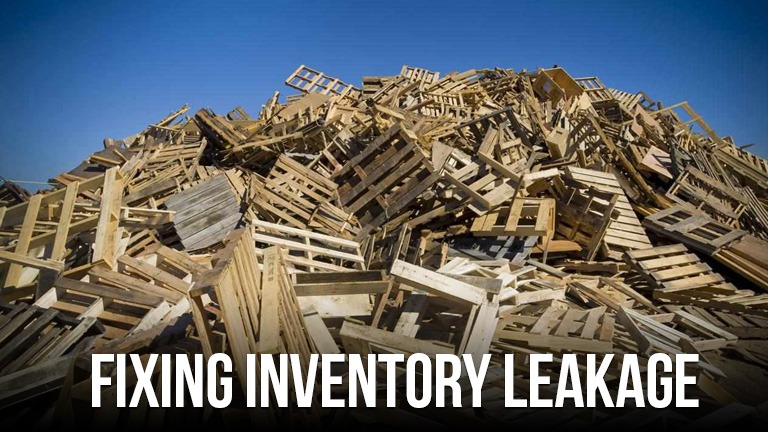
Then someone goes outside and shows them the stacks of pallets in the yard.
How is it possible that there is a shortage?
It is not necessarily about the raw count of pallets. What matters to Production is not simply how many pallets are on the property at a given moment, but how many of the right size, specification and condition are available when the line needs them.
Those can be two very different numbers.
A stack awaiting repair is inventory. So are pallets underneath finished goods, odd sizes leftover from a program, customer-owned pallets waiting for return, and units that Shipping does not want to use.
None of these will help when Production asks for 48×40 pallets right now.
That is where the problem usually begins.
Counting pallets is easy. Knowing what you can use is harder.
One of the easiest improvements a warehouse can make is to stop giving every pallet the same status.
Current Canadian pallet-management guidance recommends separating inventory into categories such as usable, repairable and scrap, with further separation by size or grade, depending on the operation.
The reason? A reusable 48×40 pallet and a broken custom-sized pallet both show up in the overall count, but have vastly different values to the shipping floor.
This does not require a complete overhaul of the system in place.
For many facilities, the initial step can simply be to establish clear categories of what is ready to use, what requires attention and what is leaving the system.
The key is consistency.
When damaged pallets are mixed with good ones, someone has to sort through them again when the dock is busy. If different sizes are stored in the same area, an overall count is less useful. And if nobody owns the count, Purchasing can be looking at yesterday’s figures while Operations is seeing the situation today.
That is how a plant can be well-stocked on Monday morning and requesting an emergency delivery by Wednesday afternoon.
The shortage usually has its root cause before anyone calls the supplier
Pallet demand is rarely perfect.
Production runs longer than anticipated. A large customer order is pushed up. More pallets are being rejected than usual. Pallets are delayed on delivery. A certain product requires a different pallet. Pallets are not returning as quickly as expected.
Most of these are not urgent problems by themselves.
The issue arises when a combination of them occurs alongside the depletion of the usable pallet buffer.
By the time Purchasing hears “We need another load tomorrow,” there may have been a slow build-up of issues.
That is why the pallet industry is seeing increased focus on visibility rather than simply purchasing.
Pallet Trader, for example, launched its full-service Pallet Trader+ offering in Canada in June 2026 for enterprise manufacturers, distributors and 3PLs.
The model is designed to manage pallet procurement through a network rather than treating each order separately.
For an individual plant, it is much more basic:
You want to see the shortage while there is still time to address it.
Don’t ask how many pallets you have. Ask how many days you have.
This is one number that is worth knowing.
Take the number of pallets that are actually available and compare it to your plant’s recent daily consumption.
Not the industry average.
Your consumption.
If your internal records indicate that Shipping has been consuming around 120 of a certain pallet per operating day, and there are 720 usable units available, you have roughly six operating days’ worth of consumption at that rate.
The 120 is not supposed to reflect the typical Canadian warehouse – it is your consumption.
Now compare those six days to the time required by your supplier to replenish the pallet.
That is where the value becomes apparent.
If the replenishment normally takes four business days, there is some cushion. If it is more like seven, the conversation with the supplier should have happened earlier.
Now examine peaks.
If there are days at that same plant where consumption reaches 180 or 200 pallets, an average can be misleading.
What looked like six days’ worth of inventory can disappear at a much higher rate with a production peak.
There is no credible rule of thumb that determines that every warehouse should have 10%, 15% or 20% extra pallets. And there shouldn’t be.
A company that uses a common recycled 48×40 pallet with multiple regional sources does not face the same shortage risk as a manufacturer requiring a custom 12-foot machinery skid.
The buffer has to make sense in context.
The repair pile can fool you too
This one is easy to overlook.
There are hundreds of pallets in the repair area, and it is well-known that some of them will eventually get back on the floor.
But “repairable” is not the same thing as “available.”
If pallets are flowing into the repair pile faster than they are flowing back out, that repair pile is a buildup rather than a buffer.
That is why it is worth looking at the movement in and out of that category rather than the overall count. How many repairable pallets are currently waiting? How many of them have actually been returned to usable inventory this week?
That provides a much better look.
Current Canadian guidance makes a similar distinction between reusable, repairable and scrap pallets for the same reason – the mixture of those categories can make it harder to appreciate both available inventory and recovery value.
It also comes into play when you are buying recycled pallets. The delivery quantity represents what came in. What met your receiving requirements represents what went into usable inventory.
Those are not necessarily the same number.
The other side of the problem: too many pallets
Oddly enough, the problem on the opposite side can also create a pallet shortage.
One location is buying more while another has stacks waiting to be removed.
One department is short on usable pallets while another area has recoverable units that nobody has sorted.
Or simply that pallets remain in the yard long enough that nobody is certain what is usable any longer.
There is some interesting data on pallet recovery available in Canada to illustrate how active the process can be.
CHEP reports that its less-than-truckload recovery program (which began in the Greater Toronto Area and subsequently expanded into Montreal and Vancouver) now collects pallets from over 400 locations across five Canadian regions. One participating Toronto business specifically cited frequent collections as a means of preventing pallets from accumulating in its yard and disappearing.
That is a good reminder that pallet availability is not only about what comes across the purchasing desk. What happens to the pallet after that can be equally important.
Is it being reused?
Is it hidden behind the building?
Does it require repair?
Does it go out the door with a customer?
Can it be recovered?
Nobody expects every inexpensive pallet to be watched like a production machine. But once pallet turnover becomes so great that it is creating recurring shortages, emergency purchases or overflows in the yard, a little visibility can go a long way.
How often should you actually count them?
Once again, there is not a single frequency that applies to everyone.
The guidance in current Canadian pallet inventory suggests that daily visual checks may be appropriate for high-volume facilities while weekly counts are adequate for lower volume operations.
That is a much more sensible approach than forcing every warehouse to take the same action.
A facility using thousands of pallets does not have the same risk profile as a small operation using a few dozen.
What matters is whether the count is often enough to identify a problem before the replenishment window closes.
For a critical pallet, the basic information should be easily understood:
– How many are usable today?
– What level of consumption are we seeing?
– What has already been allocated?
– How many are realistically returning from repair?
– When is the next confirmed delivery?
If the people responsible for Production, Shipping and Purchasing can answer those questions, pallet shortages are no longer mysterious.
Custom pallets need a different warning point
Standard pallets sometimes have fast replenishment options.
Custom pallets have another.
A 10-foot or 12-foot skid may require specific lumber lengths, a saved drawing, particular blocking or a dedicated production run. An export crate may call for heat-treated material and an approved build specification.
Waiting until the last few units are gone is much more risky.
That is why the supplier relationship is worth examining.
If a custom design is recurring, the supplier should have the specification on file. If volume is rising at predictable points, that conversation should happen before the peak. And if the pallet is so critical that its absence could halt production, it is worth qualifying a backup supplier rather than waiting for the shortage to occur.
The goal is to give the supplier enough lead time to produce the pallets that are actually needed.
Before the next emergency order
When somebody says, “We have plenty of pallets,” the easiest way to proceed is to ask:
How many could we put underneath today’s product?
Then Ask:
At our current usage rate, when will those run out?
Those two questions generally tell you a lot more than the overall count of pallets.
For manufacturers and warehouses throughout the Lower Mainland and BC, Geo Pallet can support recurring supply of new, recycled and custom pallets (including heat-treated export pallets) as well as pallet pickup and recovery. If emergency orders continue to arise, the problem is not necessarily more pallets everywhere. Sometimes the starting point should be understanding what pallets are available, where the unusable inventory is accumulating, and whether replenishment is being triggered early enough.
References & Further Reading
Pallet Enterprise — Pallet Trader Expands into Canada
August 31, 2026. Covers the Canadian launch of Pallet Trader’s managed pallet services for manufacturers, distributors and 3PLs, including procurement and network-level pallet management.
https://palletenterprise.com/21169-2/
CHEP Canada — How Small Businesses Score Big Wins with CHEP’s LTL Program
CHEP’s Canadian case study reports pallet recovery from more than 400 locations across five Canadian regions after three years of the LTL program.
https://www.chep.com/ca/en/how-small-businesses-score-big-wins-cheps-ltl-program
Pallet Pickup Canada — How to Manage Pallet Inventory Efficiently
June 27, 2026. Discusses separating usable, repairable and scrap inventory, count frequency, multi-site visibility and pallet replenishment/recovery triggers.
https://palletpickup.ca/2026/06/27/how-to-manage-pallet-inventory-efficiently/
If pallet shortages keep appearing even when your inventory looks healthy, Geo Pallet can help review pallet usage, specification mix and replenishment requirements and build a more predictable standard, recycled or custom delivery program.