“It’s going to the U.S. We don’t need heat-treated pallets.”
For some Canadian shipments, that can be true.
But it is not a very good rule for the shipping department to work from.
Canada and the continental United States currently have an exemption that allows qualifying wood packaging material to move without an ISPM-15 mark. That exemption is important, but it comes with conditions. An unmarked pallet sitting in a Canadian warehouse doesn’t qualify simply because the truck is heading south.
You need to know something about the pallet itself.
Where was it produced? Where did the wood originate? Has the pallet previously come in from overseas? Has it been repaired? And where in the United States is the shipment actually going?
Those questions matter more than whether somebody in the warehouse remembers being told that “U.S. pallets don’t need a stamp.”
What CFIA requires
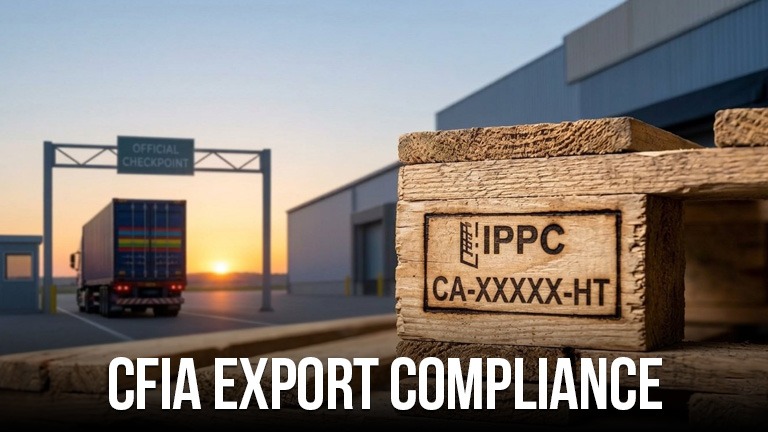
The Canadian Food Inspection Agency says wood packaging exported from Canada to the United States may be inspected to confirm that it either meets ISPM 15 or qualifies for the Canada-U.S. exemption.
For qualifying unmarked wood packaging, the shipping documents need to establish that the packaging was produced in Canada and/or the United States and made from wood originating in Canada and/or the U.S. The packaging must also be free of live pests, weed seeds and soil.
So a pallet manufactured in British Columbia from qualifying Canadian or U.S. wood and properly covered by the shipping documentation may move to the continental U.S. under the exemption without an ISPM-15 mark.
That is very different from saying:
“Anything leaving Canada for the U.S. is exempt.”
It isn’t.
And there is another detail that is easy to miss: the exemption is for the continental United States. CFIA specifically states that Hawaii and U.S. territories are not covered by it.
The destination therefore matters before the pallet is selected, not after the load has been built.
The recycled pallet in the corner is where things get interesting
New pallets with known sourcing are relatively easy to discuss.
Mixed pallet pools are harder.
Picture a warehouse that receives domestic products, Canadian imports and overseas freight. Empty pallets are recovered and eventually find their way into the same general storage area.
A shipping employee preparing a U.S. order sees a good-looking pallet and uses it.
Where did that pallet come from?
If nobody knows, the fact that it is currently sitting in Canada doesn’t establish that it was produced from Canadian or U.S. wood.
CFIA addresses this directly. Wood packaging that was not produced in Canada or the United States needs an appropriate ISPM-15 mark for U.S. movement, while qualifying unmarked Canadian/U.S. packaging relies on the exemption and supporting documentation.
This doesn’t mean recycled pallets shouldn’t be used for cross-border shipments.
It means unknown origin and export compliance are a poor combination.
For companies shipping regularly into the U.S., separating the approved outbound pallet pool can be much easier than expecting someone at the dock to investigate the history of every pallet while loading a trailer.
A stamp doesn’t necessarily tell you the whole story either
Suppose the pallet already has an IPPC mark.
Good.
Now look at what has happened to it since it was originally certified.
Has it been altered?
Has someone replaced broken components?
CFIA’s Canadian Heat-Treated Wood Products Certification Program makes an important distinction here.
Certified WPM that remains compliant and has not been repaired, remanufactured or otherwise altered can be reused without being treated again.
A repaired unit is one where up to approximately one-third of its components have been removed and replaced. When the certification is being carried forward, CFIA requires compliant repair material and prescribes how replacement components and the original certification marks are handled.
Once more than approximately one-third of the components have been replaced, CFIA considers the packaging remanufactured. Previous IPPC marks must be permanently obliterated, the complete unit must be treated again, and a new compliant mark applied.
That distinction matters in a warehouse where export pallets are routinely repaired.
A pallet doesn’t remain compliant simply because an old stamp is still visible on one stringer.
“But we built it from heat-treated lumber”
This is another conversation worth clearing up.
A company buys heat-treated lumber and builds its own crate.
Someone assumes:
“The wood was heat treated, so the crate is ISPM-15 compliant.”
Not automatically.
CFIA’s Canadian Heat Treated Wood Products Certification Program is the official framework used to produce certified wood packaging for markets requiring ISPM 15. CFIA specifically warns exporters that simply buying heat-treated wood from a hardware store is not enough to satisfy ISPM-15 phytosanitary requirements.
For certified Canadian WPM, treatment and traceability are controlled through the program and the compliant packaging carries the required IPPC mark.
Under the CFIA program, heat treatment requires the wood to reach at least 56°C throughout its entire profile, including the core, for a minimum of 30 continuous minutes.
So there is an important difference between:
wood that has been heated
and
wood packaging certified for ISPM-15 use.
For an exporter, those aren’t interchangeable descriptions.
Sometimes the simplest operational choice is still an HT pallet
The Canada-U.S. exemption can be useful. If the company knows its pallet and wood origin and maintains the required documentation, there is no reason to pretend the exemption doesn’t exist.
But businesses don’t always ship to one market.
A load goes to Washington this week. Another goes overseas next month. Pallets are reused. Warehouse staff move them between staging areas. Export destinations change.
At some point, a company may decide that maintaining a dedicated ISPM-15-compliant export pallet pool is operationally easier than determining which unmarked pallets qualify each time.
That doesn’t mean the law requires every Canadian pallet going to the continental U.S. to be heat treated.
It means compliance and operational simplicity are two different decisions.
A company with very controlled Canada-U.S. flows may be comfortable using the exemption.
A company with mixed international destinations and mixed pallet pools may decide that standardizing its export packaging reduces uncertainty at the dock.
The right choice depends on the operation.
Before the trailer door closes
Most of this can be settled long before anybody is standing at the border.
When preparing a cross-border shipment, Shipping should know the final destination, whether the selected pallets are Canadian/U.S. or foreign origin, whether an exemption is being relied upon, and whether the shipping documents support it.
If ISPM-15 packaging is being used, someone should look at the marks before loading is complete.
If the pallet has been repaired, don’t assume the old stamp automatically settles the question.
And if the warehouse contains a mixture of domestic and previously imported pallets, don’t treat “it looks fine” as an origin record.
CFIA is clear that exporters are responsible for ensuring the wood packaging used with their shipments meets the applicable requirements.
That makes this a procurement and warehouse-control issue as much as a customs issue.
One sentence isn’t enough for your export pallet specification
Instead of telling Purchasing:
“Get pallets for the U.S.”
tell the pallet supplier where the shipments actually go.
Explain whether the pallet is new or recycled, whether it may later travel outside the continental U.S., whether it will be reused, and whether the business wants ISPM-15-certified packaging as its standard export specification.
For custom crates and machinery skids, provide the destination at the quoting stage rather than after the package has already been built.
That gives the supplier a chance to build the export requirement into the packaging from the beginning.
And it avoids the worst time to discover a pallet problem:
after the product is packed and the truck is waiting.
Geo Pallet supplies standard and custom wood packaging for Canadian and international shipments, including heat-treated ISPM-15 options where required. For an export pallet, skid or crate quote, providing the destination together with the package dimensions, product weight and handling requirements helps determine the appropriate packaging approach before production begins.
Official References & Further Reading
Canadian Food Inspection Agency — Wood Packaging Material Requirements to the United States
Current CFIA guidance covering ISPM-15 compliance, the Canada-U.S. exemption and requirements for wood packaging moving from Canada to the United States.
https://inspection.canada.ca/en/plant-health/forestry/exports/wood-packaging-u-s
Canadian Food Inspection Agency — D-13-01: Canadian Heat-Treated Wood Products Certification Program
Official Canadian directive covering heat treatment, certification, marking, reuse, repair and remanufacture of certified wood packaging material.
https://inspection.canada.ca/en/plant-health/invasive-pests-and-plants/directives/date-originally-issued/13-01
Canadian Food Inspection Agency — Canadian Heat Treated Wood Products Certification Program
CFIA overview for exporters and information on sourcing certified heat-treated wood products and packaging.
https://inspection.canada.ca/en/plant-health/forestry/exports/ht-program
Canadian Food Inspection Agency — Wood Packaging Questions and Answers
Practical CFIA answers concerning Canadian exporters, reused WPM, repaired/remanufactured packaging and U.S. shipments.
https://inspection.canada.ca/en/plant-health/forestry/imports/wood-packaging/questions-and-answers