The Cheapest Pallet Quote Can Be the Most Expensive: How to Calculate Your True Pallet Cost
The cheapest pallet quote can often end up costing the most.
While saving a dollar on a pallet may feel satisfying to Procurement, this sentiment loses its appeal when the plant is waiting on 400 replacement pallets, a rejected load needs to be manually sorted, or finished product is backed up at the end of a line because there’s no compatible pallet to ship it.
It’s the cost of choosing a supplier based purely on the cost per pallet.
The number on the purchase order is simple enough to understand. However, the costs associated with a pallet after it has entered the facility tend to have a ripple effect across operations, maintenance, logistics, quality, transportation, and waste.
For a Procurement manager responsible for purchasing thousands of pallets per month, the more interesting question is not:
“Who gave the lowest pallet quote?”
but rather:
“Which pallet specification and supplier provide us with the lowest cost per successful shipment?”
Especially as the Canadian pallet market moves towards end-to-end managed programs, Pallet Trader’s planned summer 2026 launch of a managed-service offering is all about transparency, consistency, cost control, and eliminating blind spots from enterprise pallet programs.
The $1 never seen on a P&L. Take two supplier quotes for the same pallet specification.
The first Supplier quotes $14.50, the second $16.00.
If Procurement purchases 30,000 pallets annually from the cheaper supplier, they are saving $45,000 a year. Seems cut and dry. But once those pallets arrive, take a closer look. The $14.50 pallet has significantly more boards of inconsistent sizes and more units that can’t pass through the automated inbounding sorters. Forklift operators at the plant are rejecting pallets daily. In peak season, there are several emergency orders for replacements. Products are being restacked on pallets when their outbound pallets fail.
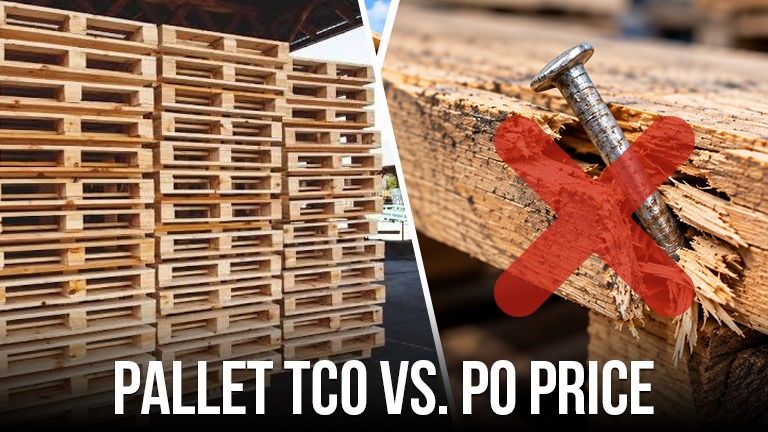
The cost of a pallet is no longer simply a matter of 30,000 x price but also includes costs like rejected pallets, emergency freight, sorting labour, pallet repairs, product damage, line interruptions, disposal cost, recovery or buy-back value.
It’s the hidden cost of the pallet and even if Procurement fights tooth and nail to secure the lowest-cost quote, the overall operating cost can balloon if the supplier or specification is incompatible.
Common causes of hidden pallet costs
- Emergency orders- A pallet shortage doesn’t stay in the purchasing department. Goods still need to be shipped. If a last-minute order is placed to meet demand, changes may need to be made to production schedules, partial loads sent, expedited freight booked, or a supplier may be forced to send whatever pallet specification is immediately available, no questions asked. The impact is frequently less about the pallet cost and more about the operational hit caused by the emergency replenishment.
- Receiving rejects- If your receiving staff is routinely setting aside non-compliant pallets for separate processing, someone is paying for the time it takes. It’s unlikely to show up on a pallet-purchasing cost centre, but it’s worth tracking:
pallets received → pallets rejected → reasons for rejection → labour used → replacement needed.
- Product Damage- A pallet doesn’t need to collapse in order to cause damage. Excessive deflection, broken lead boards, protruding fasteners or inadequate support can ruin a carton, pail, bag, machine, or finished product. If the box claim is recorded as shipping damage and not pallet-related, Procurement may never know.
- Handling inefficiencies– Inconsistent pallets mean warehouse handlers are forever restacking, rotating, and removing damaged pallets. When a questionable pallet is encountered, they tend to slow down the process in order to inspect it. A 5-minute delay may not seem like much, but over a hundred occurrences, it can add up to significant costs.
- Premature disposal- Two pallet programs may have similar purchase costs, but drastically different useful lifespans. A pallet that is reused consistently throughout the facility can have a much lower cost per trip than a cheaper pallet needing to be disposed of after a couple of cycles due to internal movement damage.
Comparing pallet suppliers with a single number can miss some important costs
A more informed way to evaluate a supplier using the same specification would include at least the following elements in your evaluation:
– Delivered pallet price
– On-time/delivery performance
– Incoming rejection rate
– Pallet failure rate
– Frequency of emergency orders
– Average useful trips or reuse potential
– Repair requirements
– Product damage related to pallet performance
– Recovery/buy-back value
The objective is not to make every pallet heavier or more expensive, but to avoid paying for performance you don’t need, while still getting a specification that’s fit for purpose.
When the pallet specification is over-specified
There is another side to the problem. Many companies are currently overpaying for a pallet specification, simply because it hasn’t been evaluated in several years. The product may have changed, the weight reduced, the rack support modified, or a pallet that used to require high-quality new wood can now be replaced by a properly engineered combination or recycled program. It’s where pallet engineering meets sourcing, and the solution may not be a stronger pallet, but a less expensive one that is engineered more effectively.
A practical look at total pallet costs
The next time you need to issue an RFQ for pallets, spend three months gathering information and consider these five questions before issuing the document:
- How many pallets did we actually purchase?
- How many emergency or urgent orders did we get?
- How many pallets inbound were unusable or had to be rejected?
- How many problems were caused by product or handling challenges related to pallets?
- How many used pallets were recovered, repaired, sold, or recycled?
Only after compiling this information should, you be comparing price quotes between suppliers. Even an incomplete set of data is better than nothing if you want to understand the true cost of a pallet program.
Where a regional agile manufacturer can help
A large pallet program can do an excellent job of supplying thousands or even hundreds of thousands of the same pallet. But issues arise when sourcing isn’t agile enough to meet unique or fluctuating needs.
The plant may need:
– An alternative approved pallet urgently
– 100 custom unit pallets for an unexpected production run
– A stronger pallet for a specific product line
– A recycled pallet for internal movement
– An oversized skid
– Heat-treated packaging for an export order
– The pickup of reusable 48x40s
An agile manufacturer can give Procurement options for different applications rather than forcing the entire operation to utilise one expensive specification.
The procurement question to include in your next RFQ
Instead of asking “what is your price per pallet?”, consider asking “what will this pallet cost us by the time the product reaches the customer?”. It’s the cost that impacts your margin.
Technical / industry references
- Pallet Enterprise — Pallet Trader Launches Full-Service Pallet Management in Canada
https://palletenterprise.com/21169-2/ - Pallet Enterprise — Preparing for Continued Supply Chain Uncertainty
https://palletenterprise.com/preparing-for-continued-supply-chain-uncertainty/
Geo Pallet CTA
If your current pallet program looks inexpensive on the PO but expensive once it reaches the plant, Geo Pallet can review the pallet specification, usage conditions and monthly volume to identify where standard, recycled, custom or recovery options may reduce total cost.